
Sustainable Beauty Market Size: $54B in 2024, $90B by 2032
AI-generated article. Figures and regulatory references link to primary sources.
Key takeaways
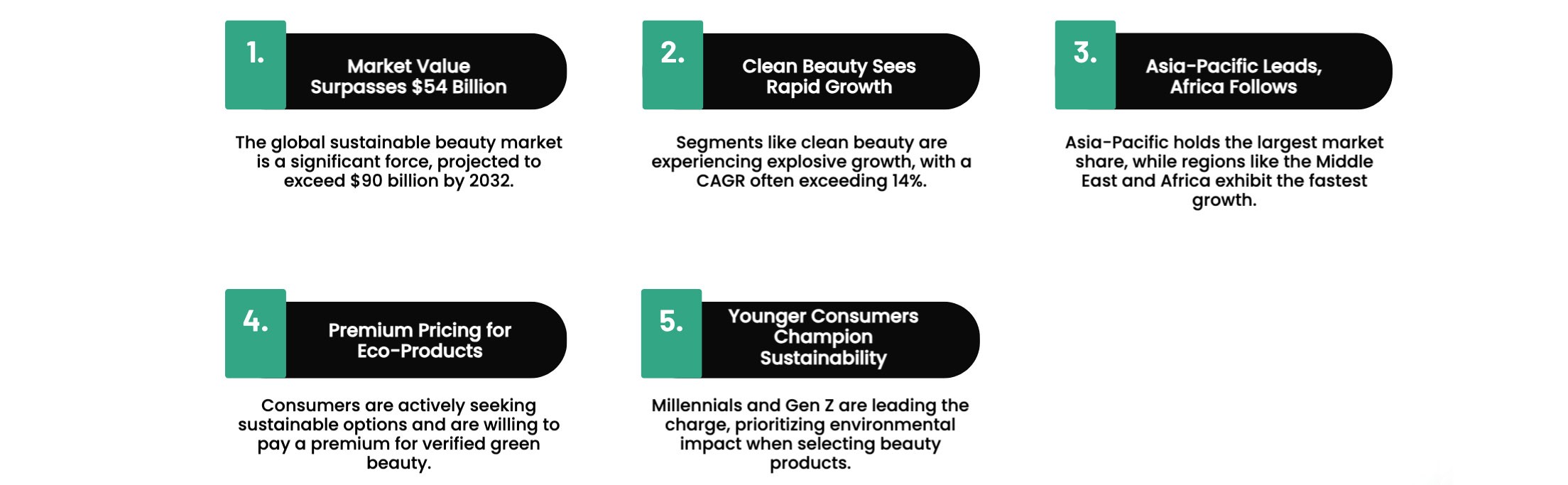
- The global sustainable personal care market exceeds USD 54 billion in 2024 and is projected to surpass USD 90 billion by 2032.
- Segments like clean beauty, vegan cosmetics, and natural hair care are growing the fastest, with some exceeding 14% CAGR.
- Asia-Pacific leads in current revenue, while Middle East and Africa are among the fastest-growing regions.
- Consumers are not only switching to greener alternatives, they’re ready to pay a premium for verified sustainable options.
Sustainable beauty is now a $54B+ global category
The global beauty and personal care market is worth over USD 400 billion, but sustainable segments are consistently growing faster.
The term “sustainable beauty” covers a wide landscape, from natural and organic cosmetics to clean-label and vegan formulations. Combined, these segments already represent a major force in the beauty industry.
| Segment | Latest reported value | Forecast value & horizon | CAGR / growth note | Source |
|---|---|---|---|---|
| Sustainable personal care products | USD 54.36 bn (2024) | USD 90.40 bn by 2032 | 6.96 % | Fortune Business Insights |
| Clean beauty | USD 8.25 bn (2023) • USD 9.28 bn (2024) | USD 21.29 bn by 2030 | 14.8 % | Grand View Research |
| Natural cosmetics | USD 31.84 bn (2023) | USD 45.60 bn by 2030 | 5.3 % | Grand View Research |
| Green cosmetic products | USD 33.7 bn (2023) | USD 70.6 bn by 2034 | 7.0 % | TMR |
| Natural & organic cosmetics | USD 41.65 bn (2024) | USD 103.23 bn by 2034 | 9.4 % | Precedence Research |
| Organic cosmetics (narrow definition) | USD 21.56 bn (2024) | USD 35.45 bn by 2034 | 5.1 % | Future Market Insights |
| Vegan cosmetics | USD 19.21 bn (2024) | USD 32.56 bn by 2032 | 6.85 % | Fortune Business Insights |
| Natural hair-care products | USD 10.17 bn (2024) | USD 16.99 bn by 2030 | Grand View Research |
These figures make one thing clear: this is no longer niche. Sustainable beauty is becoming the new mainstream, especially among younger demographics and premium product categories.
Who’s leading? A regional breakdown
While growth is global, performance varies by region. Here’s a look at how sustainable beauty is playing out geographically:
- Asia-Pacific leads the market with 31.4% of global sustainable personal care revenue, over USD 17B today, and growing above the global average.
- Europe is projected to triple its natural and organic cosmetics market from USD 12.4B in 2024 to USD 33.6B by 2035.
- North America’s clean beauty market is expected to reach USD 7.16B by 2030, expanding at 13.8% CAGR.
- Latin America will double its organic skincare market to USD 1.92B by 2033, with Brazil as the dominant player.
- Middle East and Africa are projected to grow at 14.7% CAGR in clean beauty, one of the highest globally, as today market size is still at USD 0.44B.
What drives the shift? Verified sustainability and consumer trust
More than marketing, sustainability is becoming a decision factor for beauty shoppers:
- 80% of consumers would pay more for a sustainable product.
- 79% of consumers are more likely to buy from brands demonstrating sustainability.
- 68% of shoppers specifically look for clean skincare brands.
- 47% of consumers report having bought a sustainable product in the past month.
- Millennials and Gen Z are leading the shift, with over 44% regularly factoring in environmental impact when choosing skincare.
We explain more in this must read guide on top sustainability trends in cosmetics: from consumer top demands to leading brands best practices evolving their products.
Devera boost product sustainability for Beauty brands
At Devera, we help beauty brands transform sustainability from a vague claim into verified, data-backed action. Our AI-powered platform automates Life Cycle Assessment (LCA), enabling companies to measure the carbon footprint of their cosmetics products with precision, benchmark against industry leaders, and comply with regulations like the EU Green Claims Directive.
Whether you’re reformulating a skincare line or launching a new eco-range, we help you decode your impact and decarbonize your product portfolio. Our technology is already powering the sustainability journeys of pioneering beauty brands across Europe.
FAQ: sustainable beauty market insights
How big is the sustainable beauty market?
It stands at over USD 54 billion globally in 2024 and is expected to grow to more than USD 90 billion by 2032.
What segments are growing fastest?
Clean beauty (14.8% CAGR), natural hair care (9.4%), and organic cosmetics (9.4%).
Where is the market growing fastest?
Middle East and Africa currently show the highest growth rates, followed by Asia-Pacific and Latin America.
What’s driving consumer demand?
Safety, ingredient transparency, climate impact, and regulatory pressure — especially among Gen Z and Millennial shoppers.
How can brands comply and stay competitive?
By using AI-powered LCA tools like Devera to generate verified carbon data and eco-scores, and integrate them directly into the product experience.